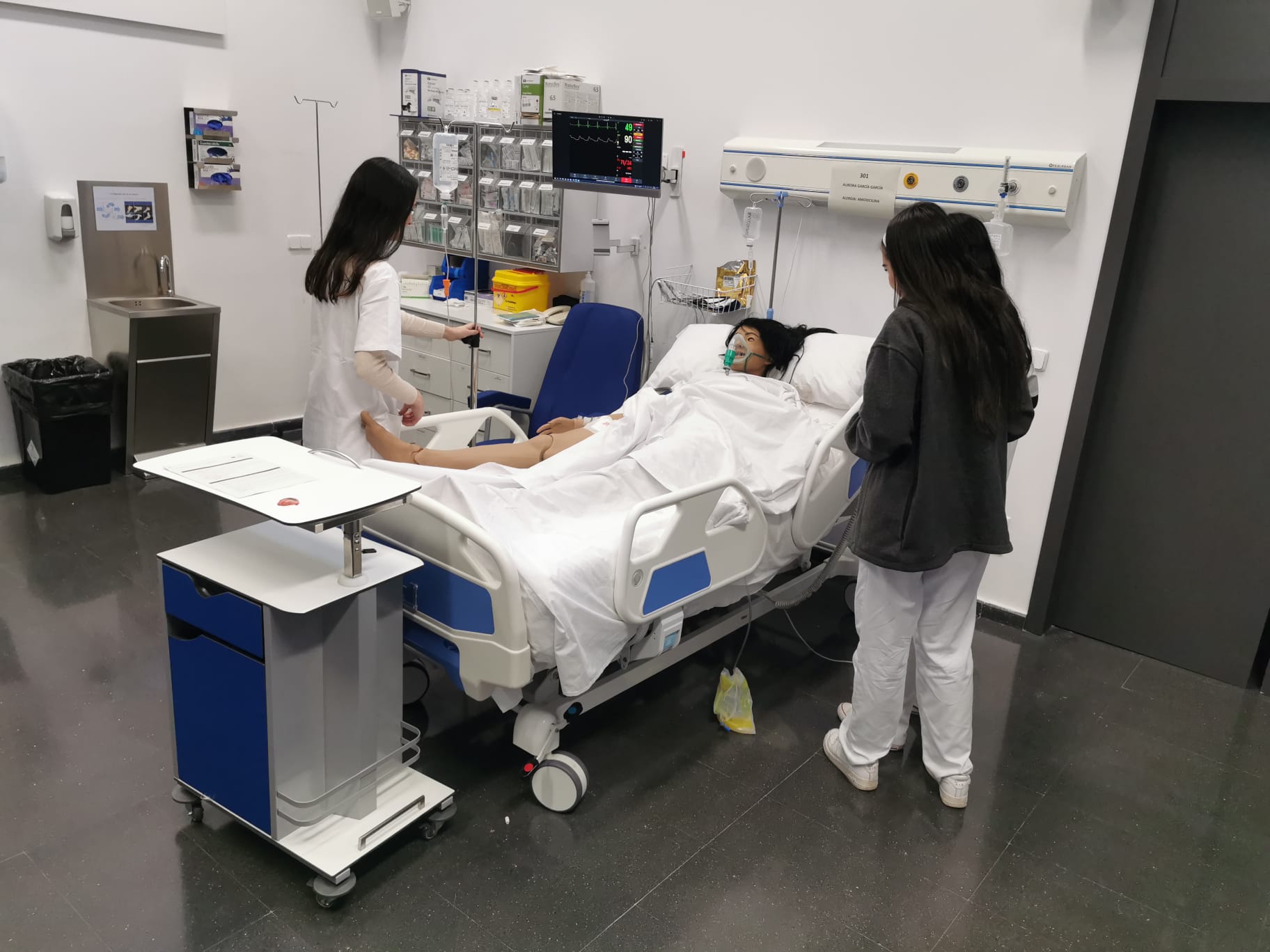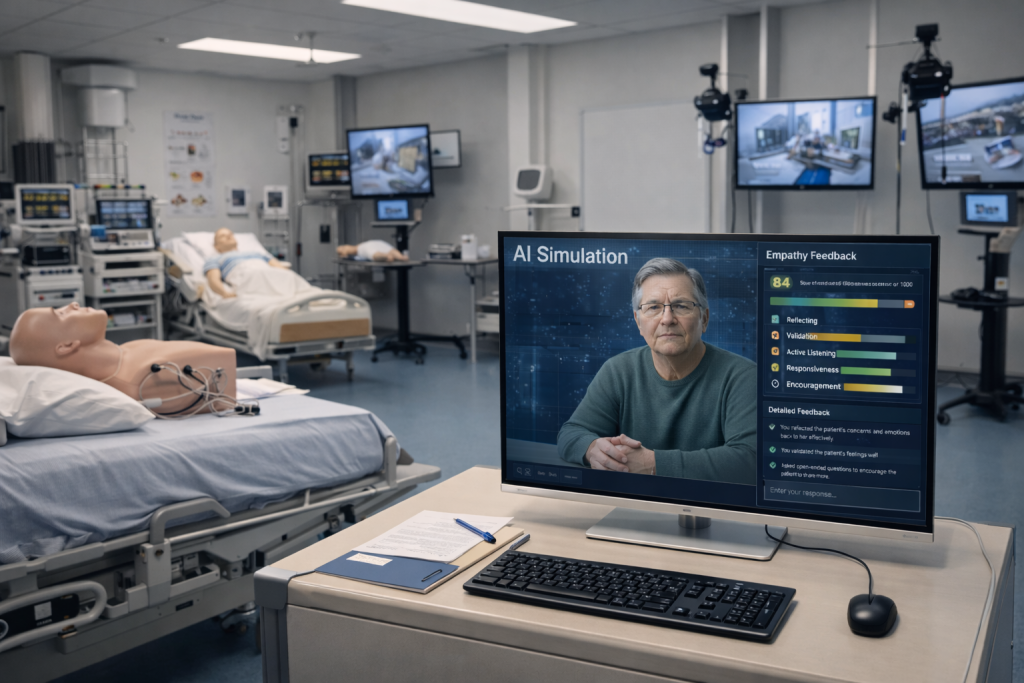


















In this article, Alemania González and Betty Bravo analyze how debriefing in simulation is strengthened when the facilitator masters the art of asking powerful questions, uses careful language, and applies a tone that encourages reflection. With recent evidence, they show how asking purposeful questions, listening actively, and regulating one’s voice transforms the experience into a critical, emotional, and meaningful learning process.
Debriefing emerges as much more than a technical review. It is a moment fraught with uncertainty, where the lived experience takes on meaning thanks to guided reflection. In this space, students not only review what they did, but also explore how they felt, question their decisions, and give coherence to what they have learned. Recent research with nursing students describes it as a shared exercise in introspection and analysis that strengthens self-awareness and builds solid bridges between academic theory and healthcare practice (1).
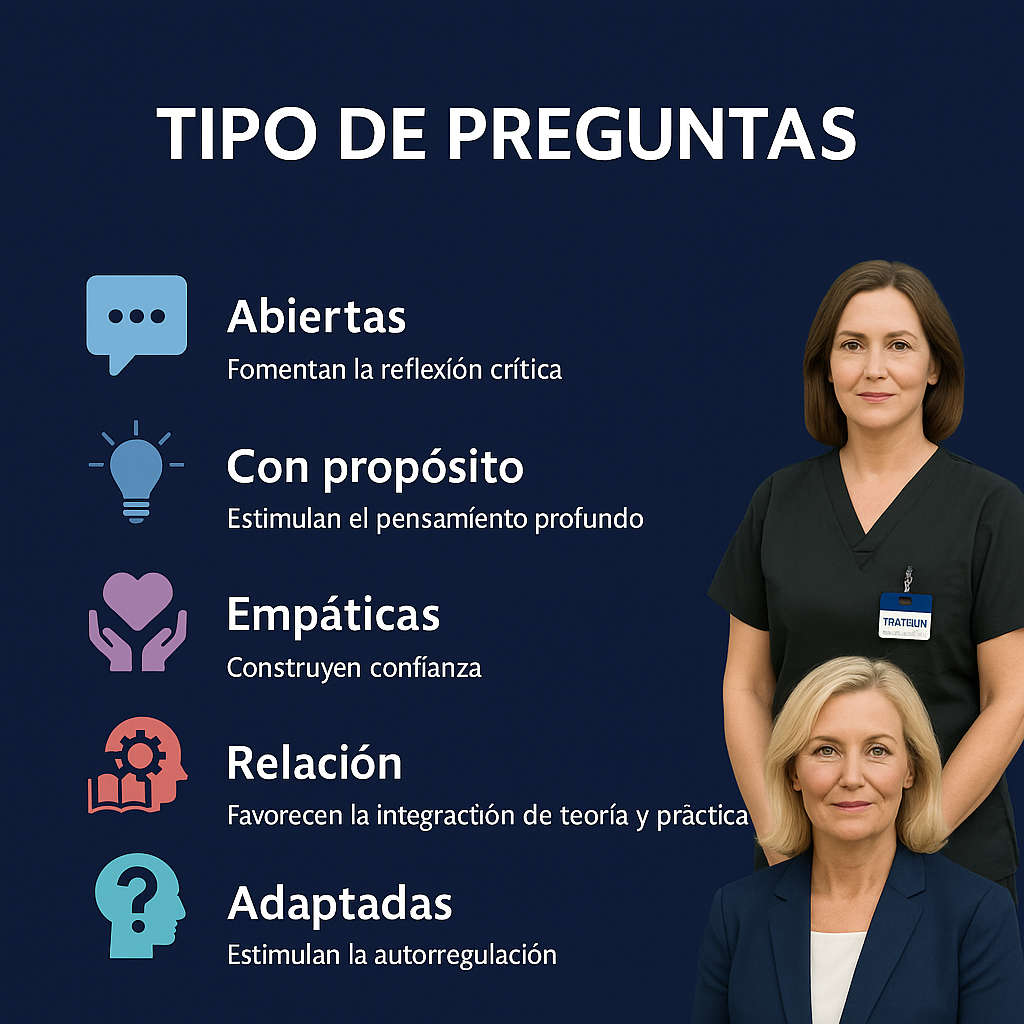
In simulation, everything starts with action, but true learning occurs in the debriefing, where the experience is transformed into understanding and learning, and that is where the art of questioning plays a decisive role. It is not about interrogating, but about opening paths. Open-ended and reflective questions such as “What did you think at that moment?” or “What would you do differently next time?” not only stimulate critical thinking, but also create an atmosphere of trust where mistakes become opportunities.
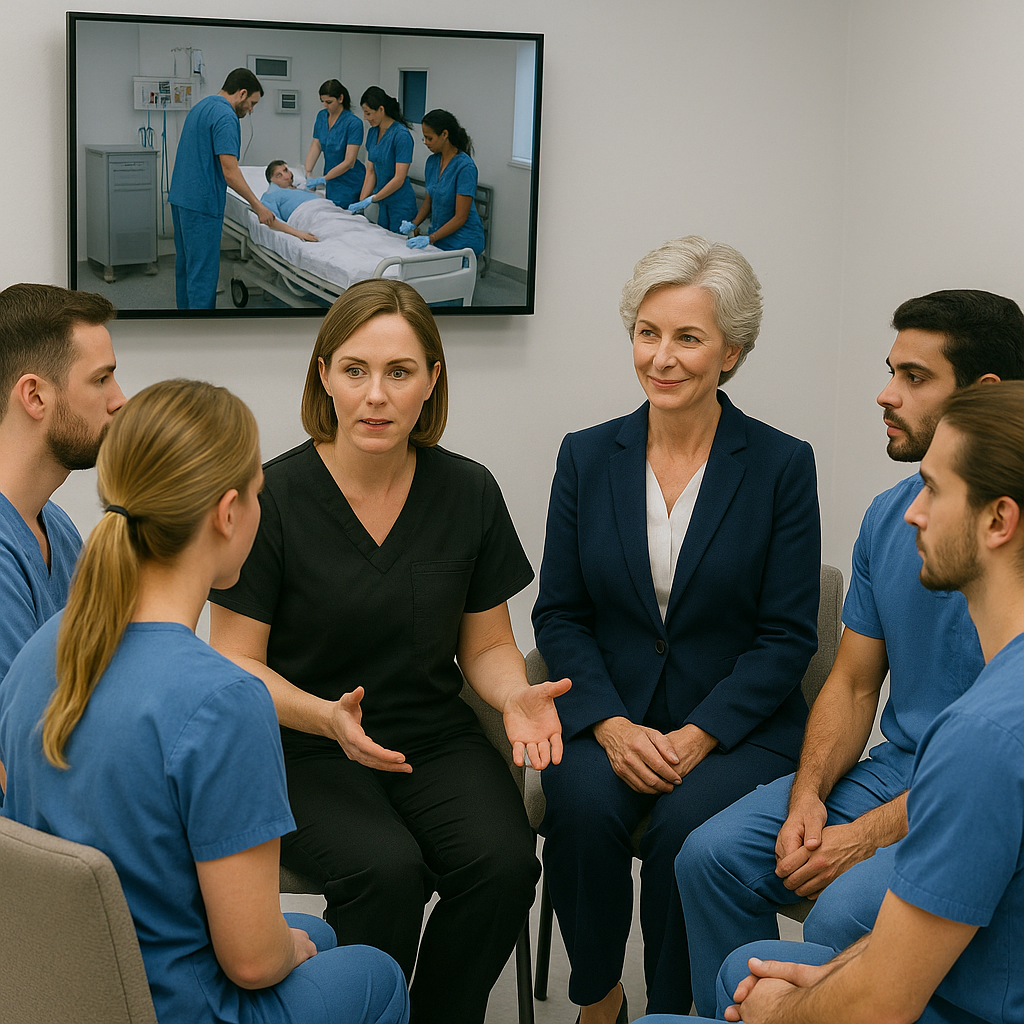
Even if a Socratic method is not formally used, experts agree that the facilitator must know how to ask questions with pedagogical intent. This ability to guide without judging, to invite people to look beyond success or failure, is what makes the difference between a mechanical exercise and a transformative experience.
The latest research confirms this: when debriefing is conducted with sensitivity, clarity, and purpose, it becomes a powerful catalyst for meaningful learning (2,3). It is a process where technical knowledge and emotional dimension are integrated to form more critical, empathetic, and aware professionals.
Debriefing is that intimate moment where action becomes reflection and experiential learning provides understanding and learning.
Asking questions with purpose
The way a facilitator conducts debriefing reveals a lot about their level of experience. The specialized literature points to clear differences: while expert facilitators tend to establish a balanced dialogue with students, novice teachers tend to dominate the conversation, transforming debriefing into an evaluation rather than a space for reflection (6). Recent studies confirm that experts ask questions that open up reflection and promote critical thinking, while inexperienced facilitators fall into an interrogative style that limits student participation and reduces learning to right or wrong (3,4).
Asking good questions is not just a technique, it is an art.
A skilled facilitator gets students to explore the reasons behind their actions and develop the ability to learn from themselves: what we know as self-regulation. However, research conducted at the Catholic University of Santiago de Guayaquil has shown that this process depends on a key factor that is often overlooked: the level of prior knowledge that students bring to the simulation experience.
During our debriefing sessions, we have observed that both the quality of the questions and the facilitator’s intervention time must be adjusted to the student’s starting point. It is not a matter of asking sophisticated questions for their own sake, but of formulating questions that really connect with what the student is able to understand and reflect on. Therefore, it is essential to design instructional guides so that students know in advance and are prepared to resolve the scenario, turning the prebriefing into a true prior learning opportunity through hybrid learning strategies or other emerging technologies that can be part of that independent work guide (7,8). Only then can the simulation experience become a meaningful experience that students not only remember, but that transforms them and modifies their mental models.
Every word counts: the language that transforms the debriefing
In the debriefing, language not only conveys information: it shapes the emotional climate, opening or closing doors to learning. “Every word matters” is not just a phrase: it is a pedagogical warning. Recent studies in clinical simulation show that positive and empathetic language creates an environment in which students feel safe to explore their mistakes without fear or shame. Phrases such as “interesting how you reasoned that decision” invite curiosity, not judgment. In contrast, a corrective or authoritarian tone can trigger defensive responses and stifle reflection (2). Expert facilitators know this: they choose their words carefully, avoid labels, and prioritize reflective accompaniment over immediate correction.
It’s not about softening everything, but about rephrasing with respect. The skilled facilitator guides with open-ended questions and neutral comments, helping the student identify areas for improvement on their own. This form of dialogue not only encourages introspection, it builds a culture of learning based on trust and shared responsibility. Because, in the end, it’s not just what we say that matters. How we say it matters. And every gesture, every pause, every word contributes to whether or not the student dares to think, speak, and grow.
Every gesture, pause, and word of the facilitator shapes the learning culture.
The power of shared reflection
In debriefing, learning takes on a life of its own. It is the moment when students identify their gaps, plan concrete improvements, and, above all, strengthen their self-confidence. In the most effective sessions, the teacher’s role is not that of a protagonist, but rather that of a silent guide who asks a precise question and allows the group to construct the answer.
Recent evidence confirms this: when students actively participate in collective reflection, the educational impact is multiplied. A study published in 2022 revealed that debriefings with horizontal interaction between several participants (known as a “network” pattern) generate deeper learning (9), both individually and as a group, compared to those where only the facilitator is involved. Listening to diverse voices, debating points of view, and constructing meaning in a shared way not only enriches the discussion but also transforms the experience into shared knowledge, because in the end, the goal is not to point out right or wrong, but to ask ourselves together: what did we learn from this?
From technique to mastery: when the facilitator also learns
Asking good questions is not an innate skill; it is an art that is cultivated with practice.
It requires active listening, empathy, and emotional control. In the context of clinical simulation, this art finds its ideal setting: each session not only trains the student, but also the facilitator. There, each experience becomes an opportunity for growth, both professionally and personally.
Conducting an effective debriefing goes far beyond following a structure or applying a technique. It involves achieving a mastery that combines pedagogical science and interpersonal sensitivity. And that mastery cannot be improvised: it is built through deliberate experience and continuous training. A study published in 2025 revealed that facilitators without formal training received significantly lower evaluations on the quality of their debriefings, in contrast to colleagues specifically trained for that task. Clinical expertise, while necessary, is not enough. The ability to facilitate reflective processes needs to be taught, practiced, and refined (2,6).
Along the way, each simulation also becomes a lesson for the facilitator. Reflecting after each debriefing—what worked? or what could have been done differently?—is an essential practice that, over time, develops fluency, intuition, and confidence. Asking good questions is an art, but it is also, and above all, a responsibility that is perfected through training, awareness, and commitment.
Effective debriefing requires pedagogical intentionality, interpersonal sensitivity, and continuous improvement on the part of the facilitator.
Practical guidelines for effective debriefing in clinical simulation
- Psychological safety from the outset
Creating a respectful and non-judgmental environment allows students to speak confidently and learn from their mistakes (3,5).
- Empathetic communication
The facilitator’s tone of voice and body language directly influence the openness of the group. Active listening and well-used pauses reinforce reflection (4).
- Asking purposeful questions
Questions should guide analysis, not seek correct answers. Open-ended and reflective questions stimulate critical thinking and self-regulation.
- Balanced participation
Involving everyone in the discussion and closing with a group summary improves understanding and reinforces collective learning (3,10).
- Constructive language
Reframing mistakes as opportunities and giving feedback from a place of empathy motivates without creating anxiety (4).
- Continuous training for facilitators
Formal training, reflective practice, and peer feedback are essential for moving from technique to mastery (2,6).]
The facilitator’s voice as a learning tool
Beyond the content of the questions, a facilitator communicates through tone, volume, rhythm, and even silence, thus marking the difference between a superficial educational experience and a truly transformative one. When volume, tone, timbre, and duration of the voice are balanced for debriefing, it is possible to convey confidence, empathy, and emotional closeness (4). It is not about talking more, but knowing when to be silent: a well-placed pause can open up more space for reflection than a long explanation.
Recent research agrees that the facilitator’s voice is much more than a vehicle for information: it is a powerful pedagogical tool. A calm and empathetic tone facilitates honest participation by students, while abrupt or rigid communication raises invisible barriers that limit learning. Active listening, validating with gestures, and allowing others to think aloud creates an environment where students feel heard and willing to explore (5). In this context, every word and every silence helps to build a respectful, profound, and shared culture of learning.
Conclusion
Ultimately, debriefing is where the experience takes on meaning, where the technique is humanized, and where the participant has the opportunity to reconstruct their own cognitive and emotional process. When conducted with purpose, sensitivity, and a clear command of pedagogical language, debriefing transcends performance review and becomes a space for professional transformation. Facilitating it masterfully means recognizing that every question, every word, and every silence has a formative impact. Investing in the preparation of facilitators, promoting a culture of psychological safety, and understanding the potential of guided reflection is, now more than ever, a necessity that responds to more complex situations in healthcare, allowing us to train professionals who are more critical, more empathetic, and more aware of their responsibility in patient care.
READ ALSO